What a big plugin sale actually means for your mixes (and when to skip it)

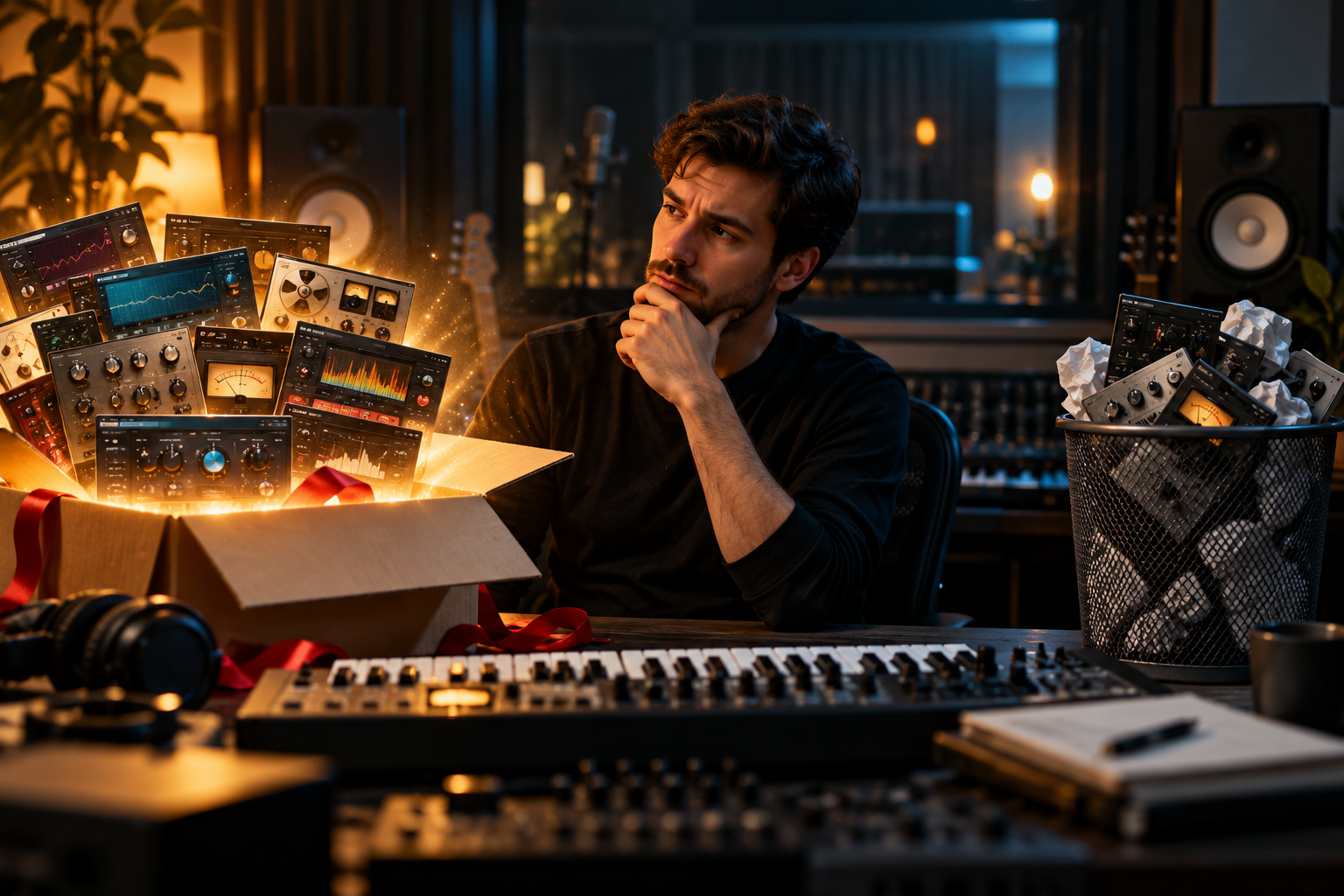
The sale email lands on a Tuesday. Forty percent off everything, sixty hours left, a countdown clock ticking in the corner of the browser. I’ve bought plugins in that window and regretted it by Thursday. I’ve also skipped sales I should have caught. The difference between those two outcomes had almost nothing to do with the discount.
Here’s what I’ve learned after a decade of small-room sessions, the kind where the drums are in the living room and the vocals happen after the neighbours go quiet.
A sale price is a discount on a decision you hadn’t made yet
That’s the whole problem. When I buy a plugin in a sale, I’m usually buying a solution to a problem I haven’t actually hit. The discount creates urgency, and urgency shortcuts the only question that matters: do I know exactly what this does that my current chain doesn’t?
If I can’t answer that in one sentence, with a specific track in mind, the purchase is speculative. Speculative purchases rarely improve mixes. They improve plugin folders.
Compare that to the times a purchase actually stuck. Every one of those came after a session where I hit a wall and knew precisely what was missing. The sale was incidental. I’d have paid full price the following week.
The free chain already covers most of the obvious gaps
This is the part that makes big sales feel less essential than they did five years ago. A working vocal chain exists for free and it’s genuinely good: TDR Nova for dynamic EQ, Spitfish for de-essing, Limiter №6 for control, Valhalla Supermassive for space, Youlean Loudness Meter to keep you honest. Those tools get used on paid work.
Nova is the one I’d point to first. Four bands of dynamic EQ in the free version, and ducking a resonant frequency out of the way with a sidechain takes about ten seconds once you’ve done it twice. For a songwriter tracking their own vocals in a spare room, that covers the boxiness and the harsh top end that a sale purchase would otherwise promise to fix.
So when a sale lands, the honest first question is: which job in my current sessions is Nova not doing? If the answer is vague, the cart stays empty.
Where paid tools actually earn it
Not in capability. In workflow and character.
That’s the split I keep coming back to. A clean EQ is a clean EQ. What you pay for is analogue modelling that has a sound you can identify, metering that goes deeper than the free options, and an interface that makes decisions faster. None of that changes what’s achievable. All of it changes how long achieving it takes.
On a session where I’m mixing someone else’s record to a deadline, speed is worth money. On my own material, where I can leave a mix open for a week, speed is worth much less. Same plugin, different value, and the sale doesn’t know the difference.
The one place I’d say paid tools clearly lead is resonance suppression. Nothing free does that job as well as soothe2. If a sale includes it, that’s a real conversation. If a sale is all compressors and channel strips, it’s probably not.
Reverb is the trap
Reverb sales get me every time, because reverb is the category where “character” is least abstract. Different algorithms suit different sources. A plate on a snare wants something different from a long hall on a lap steel, and the plugins that do those two things well are rarely the same plugin.
But the free option here is strong enough that buying more reverbs is almost always about wanting a particular colour, not needing one. Valhalla Supermassive has 22 modes of reverb and delay, it’s free, and it gets updated. The huge, wash-it-all-out settings are its specialty, and it’s easy to overuse, which is its own lesson.
When I buy a reverb in a sale now, I try to name the specific source it’s for before I click. “This is for the room mic on the drums.” If I can say that, fine. If it’s “this sounds lovely on the demo,” I close the tab.
The test I actually run
Before any sale purchase, I open the current session. Not a demo, not a test tone. The song I’m actually working on, the one that’s been fighting me.
Then I ask three things:
- Can I describe the problem this plugin solves, in one sentence, about this specific track?
- Have I already tried the free or stock tool that does something similar?
- Will I use it on the next three sessions, or just this one?
Two out of three, and I’ll consider it. Three out of three, and the sale is a bonus rather than the reason. One out of three, and I’m shopping for a feeling, not a tool.
What the discount doesn’t touch
Here’s the uncomfortable bit. Forty percent off a plugin is still money spent on a problem that might be acoustic.
If my room is ringing at 120 Hz, no compressor purchase fixes it. If my monitoring is lying to me about the low mids, a new EQ just gives me more precise ways to make the wrong decision. Acoustic treatment returns more than any plugin at the same price, and it doesn’t go on sale.
I’ve watched myself buy plugins to avoid dealing with the room. It’s a very human move and it never works. The mix still sounds like the room.
When to skip it entirely
Skip the sale if you’re in the middle of a mix. Buying mid-session is the worst possible timing: you’ll bolt the new plugin onto a track that didn’t need it, and you’ll spend an evening learning an interface instead of finishing the song. The mix you were making is the priority. The plugin will still be there.
Skip it if the discount is the most interesting thing about the plugin. Skip it if you can’t remember what you were going to use it for by the time you’ve read the product page. Skip it if you’re buying because the free chain feels like it shouldn’t be enough.
That last one is the quiet trap. Free plugins aren’t inherently worse. Buying because something is free and therefore lesser is the wrong reason, and the free chain above gets used on paid work every week.
What I’d actually buy in a sale
If a sale has soothe2 in it, look properly. If it has a reverb with a character I can name a use for, consider it. If it has a metering suite that would tell me something my current meters don’t, that’s worth a look for anyone mixing their own records.
Everything else, I try to let pass. Not because the plugins are bad. Because a sale is a discount on a purchase, and a purchase is only as good as the decision behind it. The mixes that got better weren’t the ones where I bought more. They were the ones where I finally understood what I already had.
The countdown clock is designed to stop me thinking. The best thing I can do is take the sixty hours and think anyway.