How to Record an Acoustic Guitar in a Bedroom Without Killing the Room

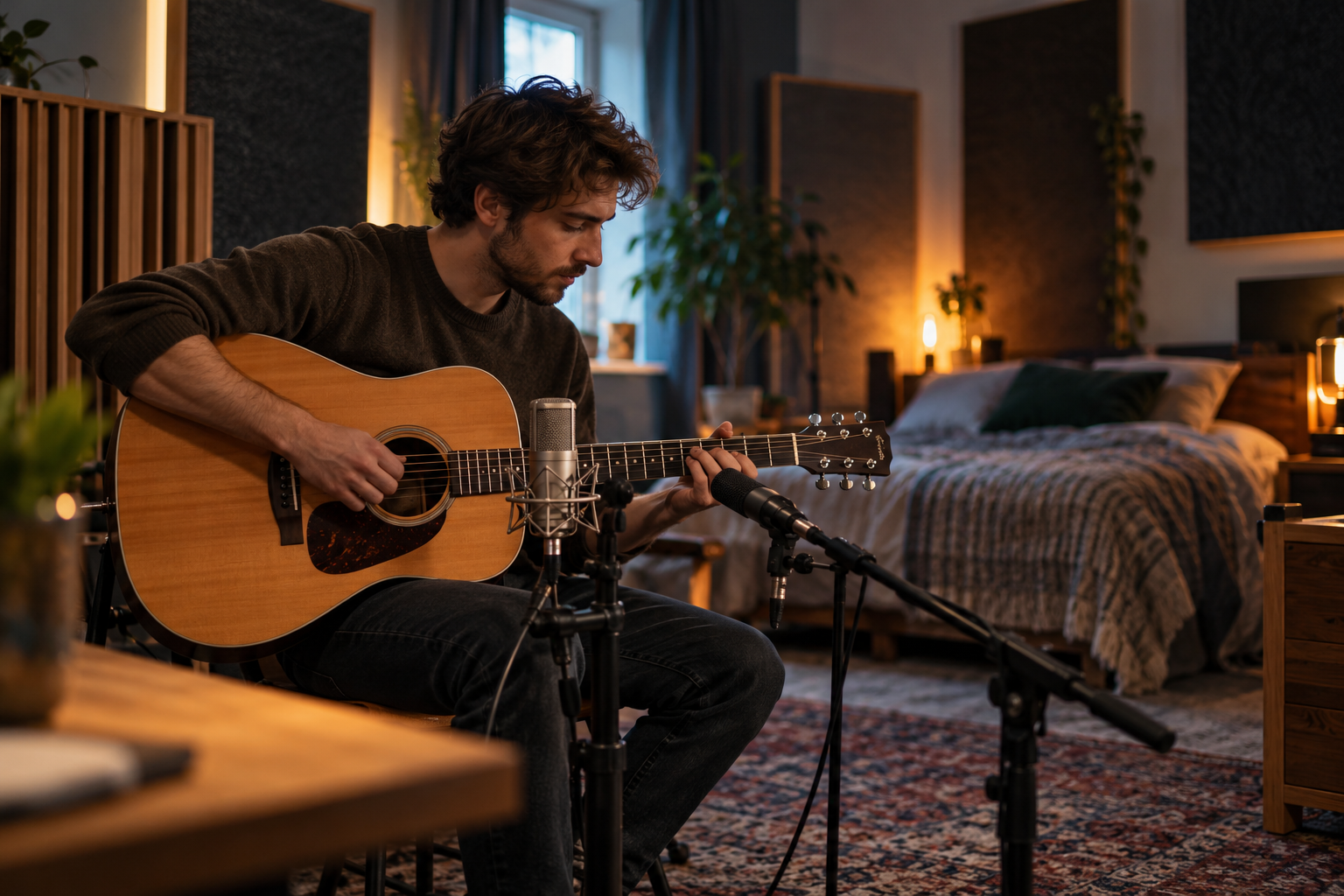
I recorded an acoustic guitar in a bedroom last Tuesday. Seven feet by nine, bookshelf on one wall, carpet over a slab. The guitarist had a lovely 000 and a heavy strum. By the third take it sounded like we’d close-miked a shoebox. Not his fault, not the guitar’s fault. My fault, for pointing a condenser at the soundhole and expecting the room to behave.
So here’s what I actually do now when someone sets up in a spare bedroom, and the small tricks that let you keep some life in the guitar without the walls showing up on tape.
Point the mic where the room is quietest
An acoustic guitar is a small box that throws sound in a big, uneven pattern. The soundhole dumps low-mid energy straight out. The upper bout, near the 12th fret, gives you string detail and less body. The bridge gives you a warmer, rounder tone with less boom. None of these are “right.” But in an untreated room, the mic placement decides how much wall you capture along with the guitar.
Aim a condenser at the 12th fret, about 20cm out and angled slightly toward the body. You get string attack and a manageable amount of low end. Then move the angle, not the distance, to add or subtract body. The closer you are, the more direct sound you get and the less room you pull in. In a bedroom, closer is almost always better. I’ve had good takes at 15cm from a cardioid condenser with a light pick attack.
What about the room reflections? Every mic that’s not a tight hypercardioid is going to hear some walls. The trick I borrow from vocal sessions: get the mic into the part of the room where the early reflections arrive later than the note. Corners are the worst. Open doorways are your friend. If the guitar is 60cm from a wall behind the player and the mic is facing away from that wall, you’re capturing less of the first bounce than you’d think.
Choose the pattern, not just the mic
Here’s the part I used to skip. On a multi-pattern condenser, the polar pattern changes what the mic hears behind and around the guitar, and that’s how you fight a bad room with the hardware you already own. Cardioid rejects the rear. Figure-8 rejects the sides. Omni hears everything, which in a dead-ish room can actually be the most honest choice.
The vocal-mic guidance I’ve read from mixing engineers says the same thing for a different source: “Condenser in a treated space, dynamic in an untreated one. A dynamic’s tighter pattern rejects room reflections, and less room in the recording is usually worth more than more detail.” That logic holds for acoustic guitar too. A cardioid or hypercardioid dynamic will give you less fairy-dust detail and much less room. If I’m tracking in a concrete spare bedroom with no treatment, I’ll reach for a dynamic before I reach for a large-diaphragm condenser, and I’ll accept the darker tone as a fair trade for not fighting mud later.
If you only have a cardioid condenser, fine. Close in. Reject with silence, not software.
Two mics, but only if you have two good spots
Stereo pairs on acoustic are seductive and usually unnecessary for a songwriting demo or an indie track where the guitar is one of six parts. A single well-placed mic that catches the part cleanly will beat a spaced pair that catches both the guitar and the bass buildup from the floor and back wall. Spaced pairs in a small room phase into a hollow, phasey mess that’s very hard to un-fix later.
If I do use two mics, I put one at the 12th fret and one at the bridge, both cardioid, and I check them in mono immediately. If the bridge mic is adding mud, I’ll flip its polarity and listen for which is tighter. If neither is great, I drop to the 12th fret mic alone and move on. A single captured take with a clear guitar is worth more in a mix than a wide pair that sounds like a small room on purpose.
And I do record DI with the acoustic pickup, always, even if I’ll throw it away. It gives me a backup for edits and, if the room was truly hopeless, something I can blend in for body.
Treat the bedroom like a vocal booth, not a studio
A few blankets on stands around the player, or behind the mic, change the character of the reflections more than people expect. This isn’t a proper recording space and it will never sound like one. But the goal isn’t a great room. The goal is a neutral-enough character that the recording won’t give away its location.
The practical check is simple: record a short burst, listen back in headphones, and use your voice as a guide. Anything you can hear between the notes (a slap off the ceiling, a ring off the floor) is the room talking. Move the mic closer, turn the guitar so it faces the softest wall, and record again. The difference between “bedroom” and “studio” often comes down to 20 centimeters and one wall.
Gain staging and editing: the boring part that saves the take
Set input gain so peaks don’t go above about -6dB. That’s standard advice for vocals and it’s good for acoustic too. Acoustic players vary wildly in attack; leave headroom for the hard strums. I’ve had a fingerstyle player sit politely at -20 and then dig into a chorus at -3 without warning. Headroom is the difference between a usable take and a digital spike.
On the editing side, resist the urge to comp every strum. The honest takes that breathe are usually the ones that hold up in a mix. Fix the fumble, leave the dynamics.
What to do with a bad room after the fact
Sometimes you record in what you have. If the guitar still sounds boxy once it’s tracked, the fix is the same as most acoustic repair: a high-pass filter to clear the low mud, a gentle cut around the boxy region (usually where the small-room resonance sits), and a de-esser for pick noise if needed. Broad, small moves. The same discipline mastering engineers apply holds up here: cleaning EQ with broad Qs and small adjustments, not surgical notching on every offending band. You will not “fix” a bad room with EQ after the fact. You’ll reduce the damage.
The real fix happens before the mic. Pick the quieter part of the room, get close, choose a pattern that rejects the walls, and record one good take. That’s the whole method. The rest is patience.